Republic of the Philippines - Stamps and Postal History
Philippine Philatelic Library
|
This is a revised version of what was originally published in the 3rd Quarter 2002 issue of the Philippine Philatelic Journal of the International Philippine Philatelic Society.
|
MODERN DAY RARITY: THE 2000 NINOY AQUINO HANDSTAMPED SURCHARGES
For the past two years or so, there has not been many exciting new
issues from Philpost, but a few collectors do know that late in 2000,
there was a really unbelievable and controversial new issue that more
than makes up for this lack of excitement lately.
Most collectors know that due to the tight financial situation at
Philpost, stamp production was drastically affected. Since the last
quarter of 1998, commemorative stamps are usually issued in quantities
of 50,000 only. The postal officials want such "expensive stamps" (cost
of production is at 65 cents per stamp, compared to less than 15 cents
for small-sized definitives) to be primarily sold to collectors and not
used for postage. They want the entire printing to be sold within six
months (now the sales period is further reduced to a ridiculous and hard
to implement three months only)!
EXCESS STOCKS / POSTAL RATES OBSOLETE
Years before, there was excess printing of most issues, and with each
new postage rate hike, many values became obsolete. Unless such stamps
are surcharged, they usually end up stocked in the vaults for many
years. Compounding the problem of obsolete stamp stocks are the huge
quantities of stamps being held as evidence in cases filed against
previous chiefs and custodians of the Philatelic Section. In recent
years, many of these obsolete stocks were taken out of storage when the
denominations happen to conform to new postage rates, or when they can
be used as "make-up" stamps and/or in combinations with others to come
up with the current rates. However, there are still a lot that remain
unusable.
For years, there were suggestions to destroy these
obsolete stamps. Unfortunately, the Commission on Audit (COA) refuses to
approve the destruction of undamaged or "good" stamps; therefore, the
most sensible way to get rid of such stocks would be to surcharge them.
However, some are in such limited quantities that if they are
surcharged, they will become instant rarities! Many others cannot be
machine surcharged because the sheets are "repaired".
(When APO-NEDA was the printer, they often
delivered sheets with one or more stamps removed due to some misprint
and they replaced these by pasting an equal number of stamps on the
sheet margins. At first, Amstar continued this practice, but later on,
abandoned this annoying method of salvaging misprinted sheets.)
For stocks that are impractical or impossible to
machine surcharge, they can be cancelled-to-order and sold on a
per-piece basis, regardless of face value. Philpost can then sell large
quantities of "collections", generating more philatelic revenues and at
the same time, supply the philatelic market with cheap stamps for
beginners, giving the hobby a much needed boost. Unfortunately, such
suggestions were never heeded.
RECOMMENDED MEASURES
Then, the unbelievable happened! The Postage Division personnel
recommended the manual surcharging of obsolete stamps with the use of
rubber stamps to the Postmaster General; and, wonder of wonders... this
crude method of surcharging, reminiscent of the handstamped "K.P "
official stamps during the Japanese Occupation and the handstamped
"VICTORY" stamps of 1944, was almost instantly approved!
The plan was to surcharge all obsolete values in "repaired" or partial
sheets, and loose stamps, and those with quantities of less than 20,000.
All such stamps with denominations lower than P5 will be surcharged to
P5 and those above P5 but below P10 will be surcharged to P10. This
involves literally hundreds of different stamps from several decades!
When I first learned of their plan to recommend such to the PMG, I
strongly objected and cautioned them against this. And even without the
knowledge of the Philatelic Division, they still went ahead with their
recommendation and got the approval quickly.
Realizing that there seemed to be no way of
stopping this, I suggested that they record the quantities of each stamp
surcharged, and control their sale strictly. Starting late October 2000
(?), the eight or so employees of the Postage Division started
surcharging the first four stamps taken out from the vaults: P2.30
Abelardo definitive of 1982, 60s Rizal's "Noli Me Tangere" of 1986,
P3.60 Aquino stamp of 1986 and 75s Christmas stamp of 1988. Each of
these stamps is to be surcharged to P5 with the use of two rubber
stamps, one for the two deleting bars and the other, for the new value.
THE SURCHARGING
I was surprised to see two kinds of new value, one with two zeroes after
the decimal point and the other with a dash instead, so I suggested that
they keep an accurate record of how many stamps were surcharged with
each of the two types. What I did not know then was that there were at
least seven distinct types of the one with two zeroes, and two types
with the dash.
It now appears that each of the manually-produced
rubber stamps was intentionally made different.
(Maybe this was to facilitate identification of the work of each
employee, I am not sure, as I was unable to get definite answers to my
queries.) They cannot even remember how
many rubber stamps were made and can no longer find any for me to use
for illustration purposes. I requested them to handstamp each type on a
clean piece of paper so that I can include the clear impressions in my
catalogue, but all they can find are the P10 rubber stamps, which have
not been used yet. In fact, they claim that there is only one type and
all the different rubber stamps are identical! This, even after I showed
them the many disparities!
CONTROLLING THE ISSUE
After they had finished surcharging the 110,000 pieces of P3.60 Benigno
Aquino stamps, they decided to start the sale. In the afternoon of
November 24, 2000, a Friday, sale of this stamp started without any
prior announcement. As recommended, they tried to control the sale. Only
three windows at the Manila Central Office were assigned to sell the
stamps. They were intended only for regular local mails, and no mint
copies were to be sold. These stamps were to be sold only to postal
patrons with ready-to-mail letters. Letters with these stamps will be
accepted by these three windows only. The tellers were even encouraged
to place the stamps on the letters, which should be left at the windows,
to be collected later in the day for processing as usual.
Unfortunately, as only very few collectors were aware that such an
"exciting" stamp would be issued, sales to collectors, who still had to
prepare covers for mailing, did not amount to much. Regular postal
patrons must have found the "regulations" too bothersome and many
refused to leave their letters at the windows, so sales were really
slow. Starting Saturday, the tellers decided to sell even mint copies,
disregarding the memo. Several collectors and dealers then took
advantage and used them on letters to be sent abroad, and on registered
letters, both local and foreign, all contrary to regulations set.
PHILATELIC / NON-PHILATELIC?
I had explained to Postage Division personnel before that any stamp
officially overprinted and sold are needed in every Philippine
collection. They insisted that these are not philatelic stamps, but
rather for postage use only, so collectors should just ignore them and
not complain. They insisted they were only doing their jobs and in the
process, they are even helping Philpost make money out of obsolete
stamps! I also explained that if they proceed with their plan to
surcharge over a hundred different stamps to higher values, Philpost
will end up losing money instead. With so many different kinds, who
would know if a surcharged stamp is genuine or not? Unless they keep a
very accurate record of which stamps were surcharged, maybe they
themselves will not know. Anybody can just have rubber stamps made and
surcharge any low value, say 60¢ or less, to P5. Collectors and dealers
can surcharge all their low value stamps, especially if they are from
incomplete sets, damaged stamps, stamps without gum, badly stained or
simply un-saleable or uncollectible stamps. And in the process, they can
even create errors and varieties. Who will be the wiser? Philpost ends
up losing more revenue instead of making a profit from this project. And
this will also wreck havoc to Philippine new issues, causing many
collectors to shy away from our stamps. No catalogue publisher will even
want to touch these issues! In the end, all of us lose!
They were, however, not a bit convinced! They did not believe there are
that many old stamps out there which people can use to create their own
surcharges. And they even reasoned that since they use hard-to-find and
expensive red ink from the meter machines, that should be enough of a
deterrent already!
THE PROTESTS
When the chief of the Philatelic Division learned about this, she
prepared a letter of protest. The International Philippine Philatelic
Society (IPPS) called for a special meeting the next day, and they also
voted to write an official letter to the PMG to denounce the sale of
such a stamp.
After receiving the two letters of protest, PMG
Rodriguez decided to suspend the sale of the surcharges at around 11
a.m. of November 27, Monday. Therefore, these stamps were officially on
sale for only about two days (Friday
afternoon, Saturday and morning of Monday).
By the time the stamps were withdrawn and put back
into the vaults, 2,065 pieces were sold, with maybe 2/3 in mint
condition. Since the issuance was not announced, only a few collectors
prepared and posted covers, making postally used (even those
philatelically inspired) covers very scarce. Furthermore, most of those
posted on the first day of sale (November
24, 2000) received a November 27 postmark,
so genuine "first day covers", especially those with proper backstamps,
are really rare!
SUSPENSION
When the sale of the Aquino handstamped surcharge was suspended, further
surcharging of the other stamps was also stopped. By that time, the
following 3 stamps were already surcharged in these quantities: P2.30
Abelardo definitive of 1982 - 25,270 pieces; 60s Rizal's "Noli Me
Tangere" of 1986 - 60,000 pieces, and, 75s Christmas stamp of 1988 -
20,000 pieces. These were sent back into the vaults, too.
As more collectors learned about the unannounced issuance and sudden
withdrawal of this surcharge, there was a unanimous cry for the
continued sale of the Aquino stamp. Since some collectors were able to
buy even mint stamps contrary to regulations, it had become speculative.
This can, in turn, only hurt Philippine philately. Many collectors
complained to the chief of the Philatelic Division, and some collectors
even sent letters to the PMG requesting that he put that particular
stamp back on sale (but to avoid approving the sale of the other three
surcharged stamps). The PMG however, did not act on this matter right
away.
RE-ISSUANCE
When it was noted that Scott's and Minkus had listed this stamp, which
was also reported in Linn's Stamp News, the chief of the Philatelic
Division wrote a letter to the PMG recommending the re-issuance of this
stamp. After over a month, the request was finally approved and the
stamps were put back on sale on December 27, 2001.
Twenty thousand (20,000) pieces of the Aquino stamps were given to the
Philatelic Division for sale to collectors, and the balance (87,935) was
sold at the windows of the Manila Central Post Office (only). But since
most collectors do not like such "controversial" stamps, which they also
find very "ugly and messy", philatelic sales remained very, very poor.
In fact, many were later sold to big mailers for postage use. When the
Internal Audit Service (IAS) people recommended that the Philatelic
Division custodian return all her stocks of old stamps to the Postage
Division for subsequent distribution to the window tellers and regional
post offices for postage use, many of these surcharged stamps were
included, too. What most collectors failed to realize was that the
Aquino stamp, an unbelievable piece in this day and age, is actually an
extremely interesting stamp. Since it was officially issued, it is
needed in every Philippine collection, and it will definitely be elusive
in a few years' time.
VARIETIES TO COLLECT
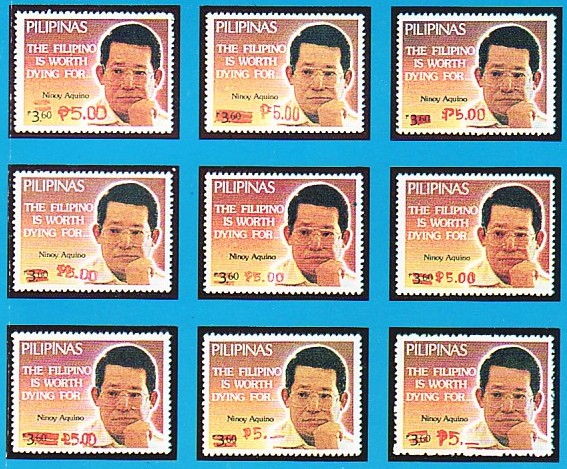
What adds to the fascination for specialists is the fact that there are
at least nine distinct varieties to collect! When the stamp was
initially put on sale in 2000, some collectors noticed that there are
different sizes of the surcharge. However, since so few were sold before
they were recalled and put back into the vaults, the complete picture
was not known until much later, when they were put back on sale.
In order to document all the different types that
may exist, and to later publicize all the officially prepared types
(so any new "finds" later will be
suspect), the entire stock of these
surcharges were examined before they were put back on sale. To our total
surprise and amazement, nine distinct types were identified.
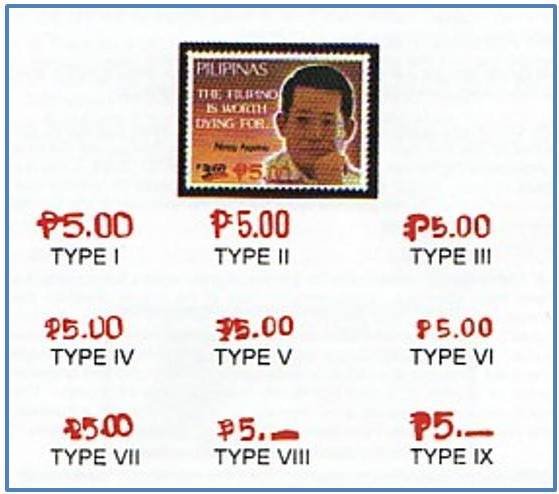
Aside from the size of the overall overprint, the shape of the peso sign
and/or numerals is different on each of these nine types. They can be
identified most conveniently and logically by the peso sign and new
value. Although there are long and short bars, uneven bars, rectangles
and blocks in place of the two bars, these deleting bars are terribly
difficult to differentiate, so it would be best not to use them as basis
for classifying. In fact, I would rather ignore the differences in the
deleting bars except when they are omitted.
Since the surchargings were done manually by the
many employees at the Postage Division, the placement of the deleting
bars, the new value and the distance between the two vary a great deal.
In fact, there is no "normal" position. Some deleting bars are placed
diagonally instead of horizontally, and since the surcharges are done in
two steps, a number of errors are known. Some have the deleting bars
omitted, others have no new value. Some have the deleting bars doubled
because the first strike missed the old value. Others have doubled or
inverted new values, too. A few sheets even have two different types of
surcharges together! Another rubber stamp was used when the employee
resumed the surcharging after leaving part of the sheet unfinished when
she stopped. (They usually do the
surcharging during lunch break, and before or after office hours.)
The poor quality of the manually-manufactured rubber stamps caused them
to deteriorate quickly, so impressions from a particular rubber stamp
made later are less distinct than those prepared earlier. The
deterioration of the rubber stamps for the two deleting bars caused
later impressions to become a rectangular or irregular block instead of
two lines. Some may even appear like they were done with a brush or
other means, but the ones who worked on them assured me only rubber
stamps were used. Obviously also, even if the same rubber stamp was
used, the amount of pressure used, angle of application and amount of
ink picked-up, all contributed to the different appearance of the
surcharges.
TYPES OF SURCHARGES
Despite such a scenario, we can still confidently
identify at least nine types. (I will give
a brief description of each type, which I hope, will help others to
identify the stamps they have.)
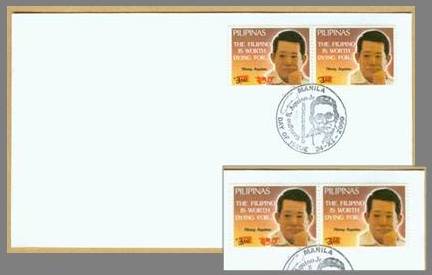
Type I on cover with official FDC Cancel
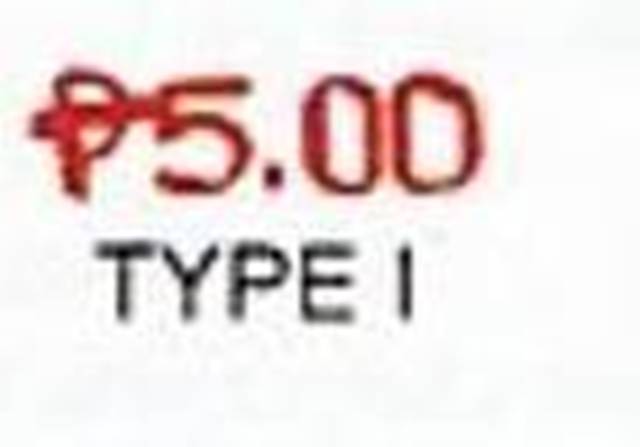
Type I.
With the largest P5.00 (12 1/2 mm. long), with a line across the center
“P” that extends out to both sides.
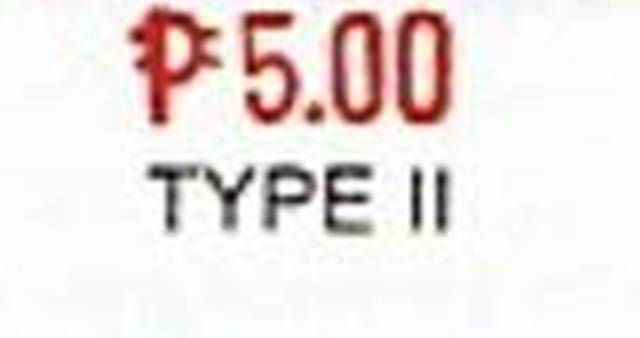
Type II.
With the tall, narrow value (10 1/2 mm.), with 2 short lines on either
side of “P”.
Type III on cover with official FDC Cancel
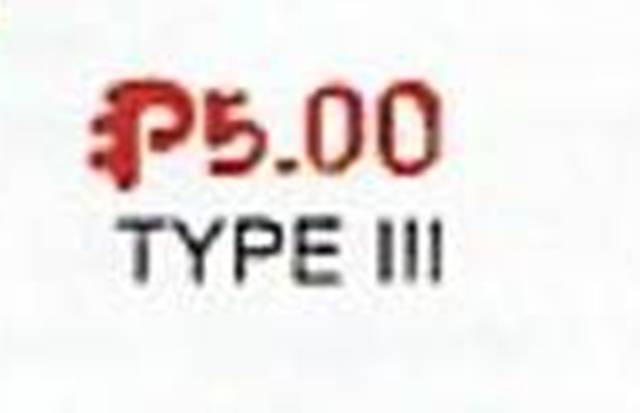
Type III.
11 1/2 mm. long, with three strokes (line or dot) at left of “P” and
with lower curve line of “P” open. There are two subtypes: one has the
horizontal stroke of “5” straight, the other has it curved upwards.
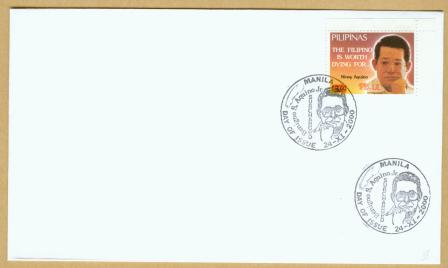
Type IV on cover with official FDC Cancel
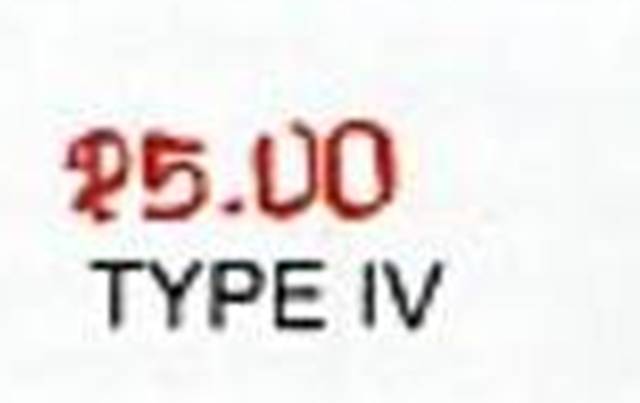
Type IV.
10 1/2 -11 mm. long, with two dots or lines at left of “P” plus
horizontal bar at foot (like in serif type). This type includes at least
three subtypes:
1.
with top horizontal bar of “5” curved, slanted down towards right,
so very close to the egg shaped curve of lower part of "5"
2.
almost identical to previous one, but with top of first zero open
3.
top horizontal bar almost straight.
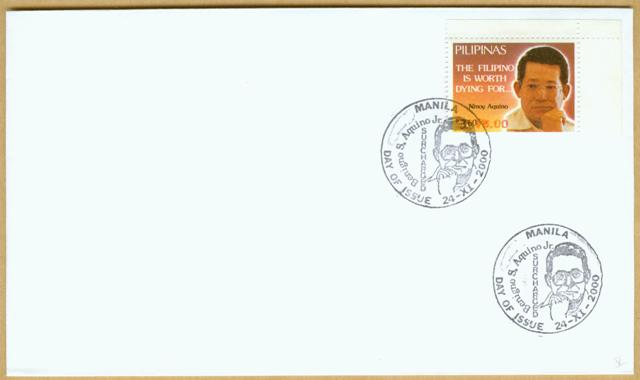
Type V on cover with official FDC Cancel
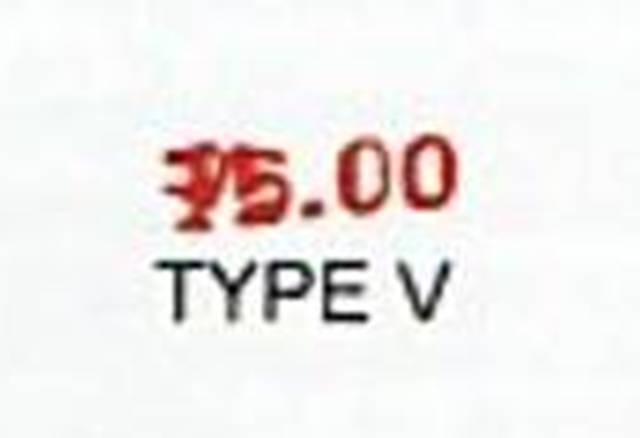
Type V.
Smaller version of type IV, measuring only 10 mm., with the “5” and two
zeroes obviously smaller and shorter. This has two subtypes, too. The
first has the horizontal bar of “5” curved and the other straight.
Properly handstamped ones do not show any zero with top open.
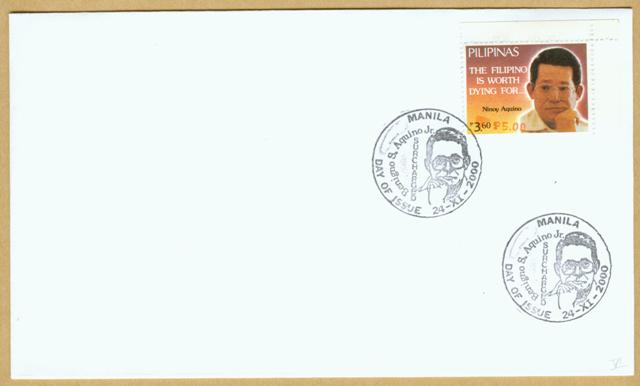
Type VI on cover with official FDC Cancel
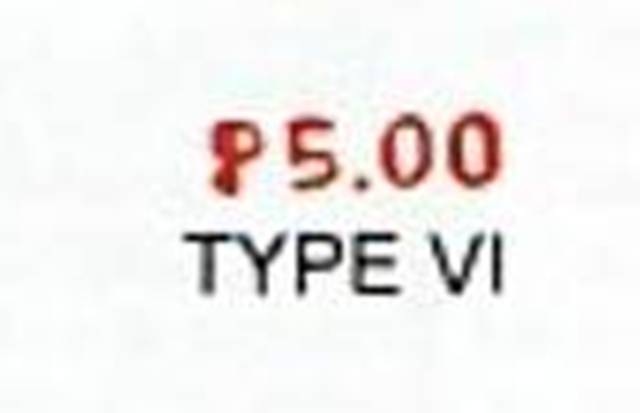
Type VI.
10 mm., with peso sign and numerals all uniform and straight
(looks sharp compared with others).
There are also three strokes (line or dot) at left of “P”, but the
bottom one is not connected to the end of the vertical stroke that
extends out to both sides, like with Types IV and V. It appears very
near the edge of the vertical stroke, with some actually joined with the
edge, but it does not cross over to the right. There seems to be two
subtypes, too: one with very thin lines, and the other, thick; but this
could be due only to differences in pressure used and/or the amount of
ink applied.
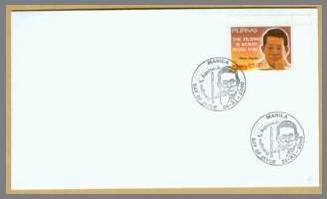
Type VII on cover with official FDC Cancel
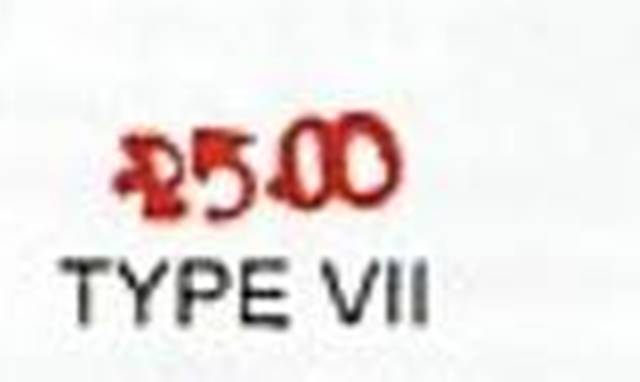
Type VII.
The smallest overprint at 8 1/2 mm. only. With a line or dot to the left
of the vertical stroke of “P” near the center. The most notable feature
is the "foot" of "P", which is an extension of the vertical stroke that
goes to the right, creating an “L".
Type VIII on cover with official FDC Cancel
Type VIII.
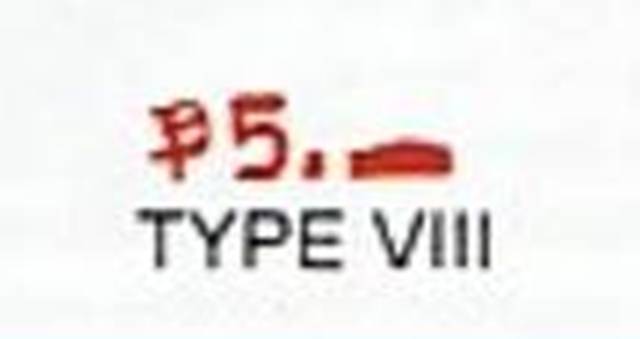
With a dash instead of two zeroes after the decimal point. 10 1/2 mm.
long and 3 mm. in height. The “P” have extensions of upper and lower
strokes of the curve line to the left of the vertical stroke. It has a
short horizontal line in the middle of the half circle of the “P”.
Type IX on cover with official FDC Cancel
Type IX.
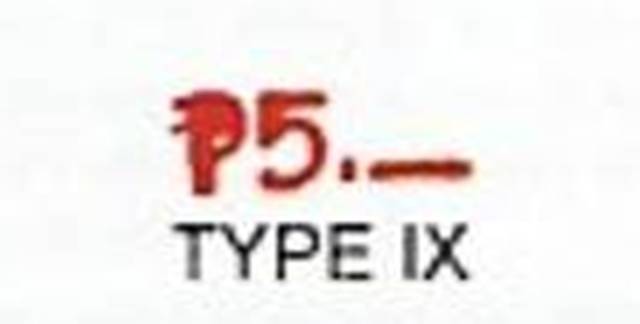
Also with a dash, but much larger, measuring 11 mm. long and 4 mm. in
height. The lower stroke of the curve line of “P” does not extend beyond
the vertical stroke, but the horizontal line in the middle of the half
circle extends out to the left of the vertical stroke. With all the
lines so thick, the whole upper half of “P” appears like a solid half
circle. Also, the top horizontal bar of “5” is very close to the upper
curve so most will show the left side joined already. To be Noted:
Types VIII & IX were used initially, but discontinued and later used
mostly on the other three stamps being overprinted. Only three sheets of
Type VIII and nine sheets of Type IX were prepared. The ones who did the
surcharging did not believe that these two types were used on the Aquino
stamp. They insisted that the one with the dash was used on the three
other stamps only. Later though, one of them remembered that they
started with this, but decided to use only the one with two zeroes after
a few sheets were done. Since all the stamps they requisitioned are
accountable, they cannot just be set aside. They simply had to include
every sheet, even these "trial sheets" and those with errors. They
honestly believed that such stamps were not collectible and were for
postage use only.
Types V and VI were never included in the stock of the Philatelic
Division and they sold out quickly at the windows, so most collectors
missed these.
Only about fifty sheets of Type II were prepared, but they were all in
the Philatelic Division stock, so many collectors got this scarce
variety.
FIRST DAY COVERS
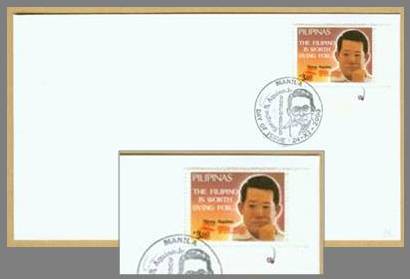
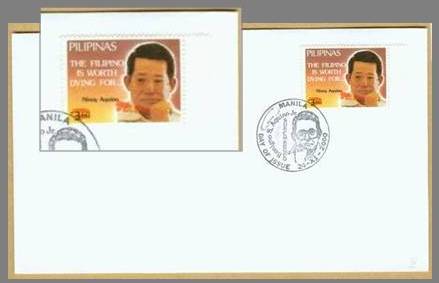
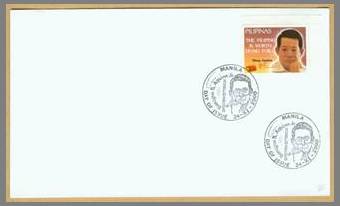
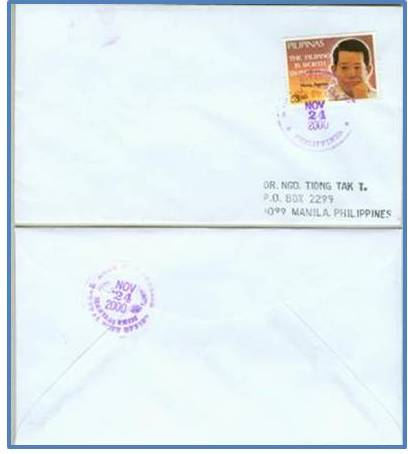
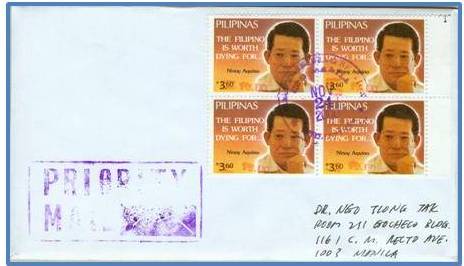
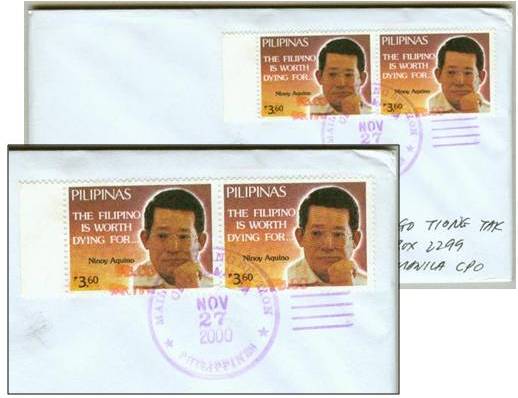
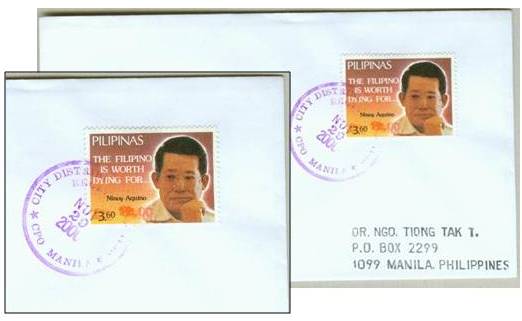
November 24, 2000 covers are considered the official FDCs and are very
RARE. Very few collectors were aware of this date, which is a
Friday. When they learned about it, they went to the next best
date that they can have covers cancelled - which is November 27, a
Monday, before the stamps were withdrawn.
FDC - Single, Postmarked Nov. 24, 2000 and backstamped Nov. 24, 2000
FDCs with November 24, 2000 backstamps are considered RARE as most have
a November 27 backstamp.
FDC - B/4. Priority Mail postmarked Nov. 24, 2000
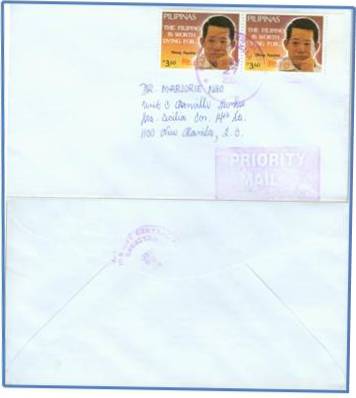
Pair. Priority Mail, postmarked and backstamped Nov. 27, 2000
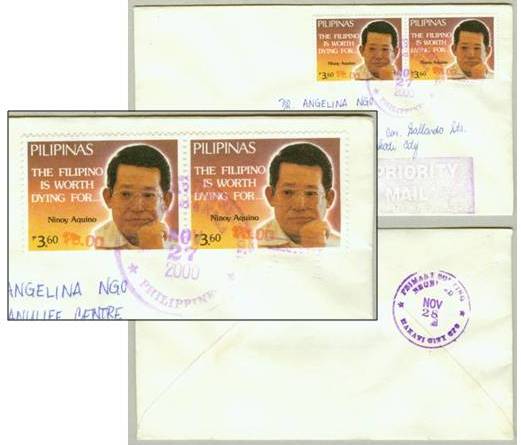
November 27, 2000 covers posted before stamps were withdrawn
Pair. Priority Mail, postmarked Nov. 27, 2000 and backstamped Nov. 28,
2000
With Error Stamps - Undeleted "P3.60"
Pair. postmarked Nov. 27, 2000
With Error Stamp (first of the pair) - Double Surcharge, One Shifted
Down
Single . postmarked Nov. 29, 2000
With Error Stamp - Double Surcharge, One Shifted Down
Single, with TB Seal, postmarked Nov. 28, 2000 and backstamped Nov. 29,
2000
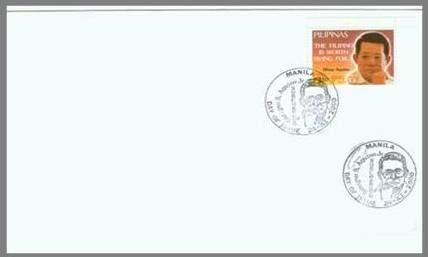
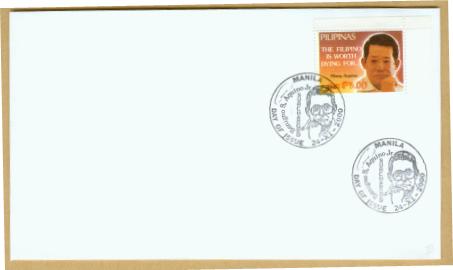
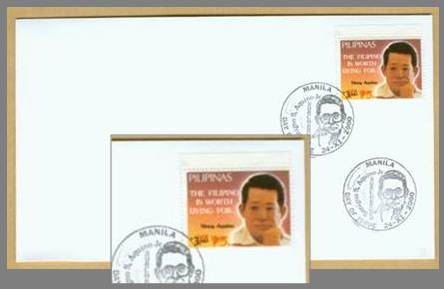
OFFICIAL FDC CANCEL DATED NOVEMBER 24, 2000 MADE AVAILABLE IN 2002
Due to the fact that the Philatelic Division was
not informed about this issue, no official first day covers nor
bulletins were prepared when the stamps were initially issued in
November 2000. Of course, when sale was suspended, such plans were also
shelved. When sales resumed, there were plans for official cacheted FDCs
and at least a mimeographed bulletin, but somehow, they were delayed for
too long. The first day cover envelopes were not ready by the end of
April 2002, so the order was finally CANCELLED as it was already way
past both "dates of issue" (November 24,
2000 or December 27, 2001), and very few
collectors seemed interested even with the mint stamps.
However, as far as an official First Day Cover canceller is concerned,
one was made available. The first day cancel, dated "November 24,
2000", was made available starting from February 2002, but only a
few collectors and dealers prepared FDCs on blank envelopes. Only very
few FDCs exist with this official FDC canceller, as the canceller was
available for a limited time only.
ERRORS, FREAKS & ODDITIES
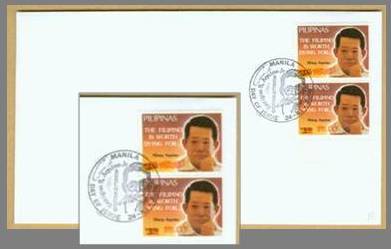
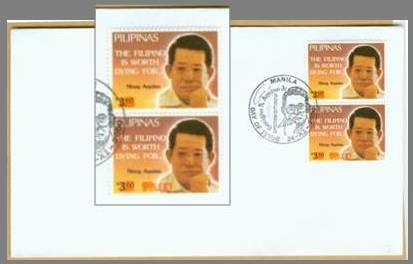
The following are some of the known EFOs, on covers with official FDC
cancels:
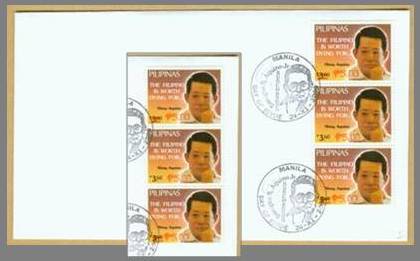
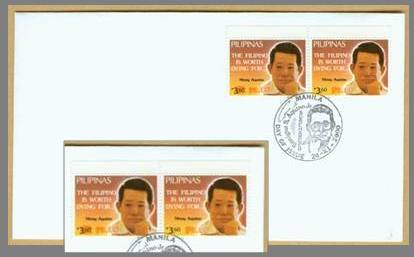
Vertical Strip of 3, Type IX. Middle stamp with deleting bars
omitted
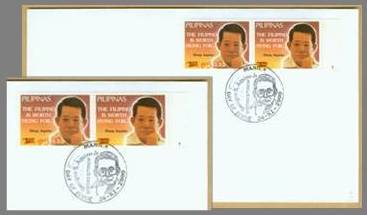
Horizontal Pair, Type I. Right stamp with new value (P5.00)
omitted
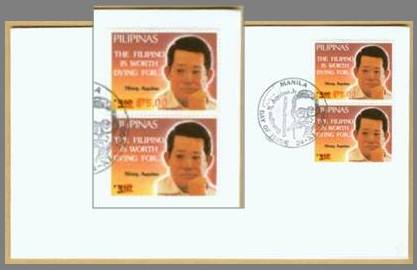
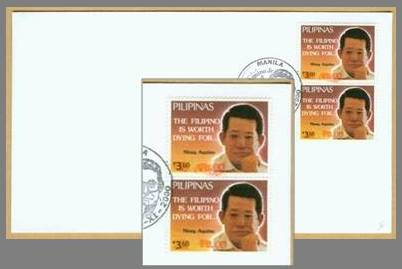
Vertical Pair, Type III. Lower stamp with new value (P5.00)
Omitted
Vertical pair, Type IV. Upper stamp with Double Surcharge
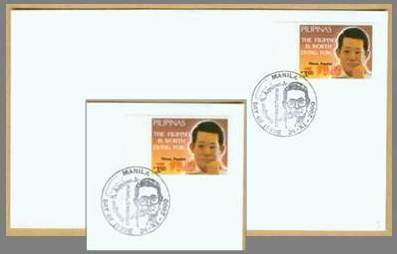
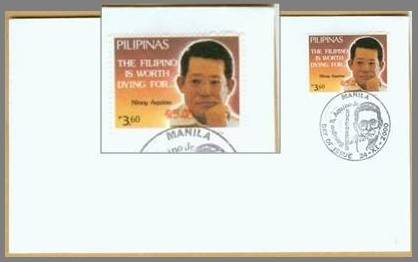
Single, Type IV. With Deleting Bars Doubled
Vertical Pair, Type IV. Upper stamp with new value (P5.00) Omitted
Single, Type IV. New value (P5.00) very far to right and slanted
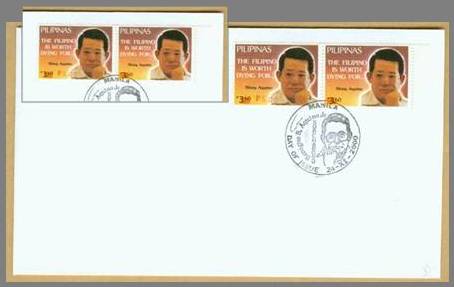
Horizontal pair, Type V. Right stamp with deleting bars omitted
Vertical pair, Type V. Upper stamp with Double Surcharge
Horizontal pair, Type VI. Right stamp with new value (P5.00)
omitted
Single, Type VII. With Deleting Bars Omitted and new value (P5.00)
very far to the Right than Usual
Horizontal pair, Type VII. Right stamp with new value (P5.00)
omitted
IN CONCLUSION....
All in all, this particular surcharged stamp is really one big
nightmare, albeit, truth to be told, to a few of us, it is one of the
most exciting and interesting stamps to come about in recent years.
Let us just hope no other similar stamps will ever be approved for
issuance by any PMG in the future.
|
Articles by Dr. Ngo Tiong Tak |
.jpg)