2010, December 22. Philippine Marine Biodiversity - Definitives
Litho Offset. Amstar Company, Inc. Perf. 13.5
Singles, Sheets of 100 (10 x 10)
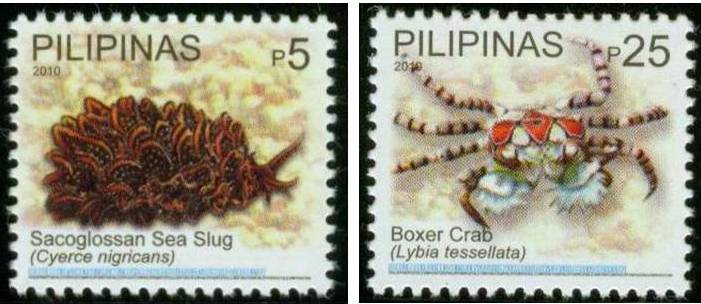
5p - Sacoglossan Sea Slug - Singles (800,000)
25p - Boxer Crab - Singles (1,930,000)
Note: The 5p Sacoglossan Sea Slug is a reprint of the 5p April 16, 2010 issue which was erroneously inscribed "Sea Hare".
Source: Coral Reef Animals of the Indo-Pacific by Dr. Terence Gosliner
First Day Covers: Manila
Sacoglossan Sea Slug (Cyerce Nigricans). The Sacoglossan is an order of herbivorous sea slugs that peaks in diversity in the tropical Pacific and Caribbean. A growing research community has begun to use the Sacoglossan as a model to dispersal, symbiosis, and speciation in the sea, because these molluscs exhibit a suite of unique characteristics. For example, many species incorporate extra-embryonic resources in their egg masses, making them ideal subjects for studying life-history evolution. They also develop as either feeding or non-feeding larvae, but a few can produce both kinds - a rare phenomenon called poecilogony. Most species can retain photosynthetically active chloroplasts from the algae they eat, and in one species a gene from the alga transferred into the genome of the slug — a discovery that has received considerable attention. Despite the widespread interest in the biology of the Sacoglossan, many species remain un-described. (http://sacoglossa.lifedesks.org/)
Boxer Crab (Lybia Tessellata). Also known as boxing crabs and pom-pom crabs. They are notable for their mutualism with sea anemones which grow on their claws for defense. In return, the anemones find new places to eat and mate. Boxer crabs use at least three different species of anemones, including Bundeopsis sp. and Triactis producta. The bonding with the anemone is not required for survival, however, and boxer crabs have frequently been known to live without them, sometimes substituting other organisms such as sponges and corals. Lybia species have been kept in aquariums with successful results. Although their anemones require more precise levels and sometimes fail to survive, Lybia species have been known to live several years in captivity. (http://en.wikipedia.org/wiki/Lybia)
-
Marine Biodiversity
-
Marine Life